Every junior in your school gets real ACT prep.
Reach is a test-prep app students actually use — 7 hours a week on average — and a system that shows your teachers exactly where the class is losing points. Most of our schools pay nothing for it.
Talk to us about your schoolWhat follows is one junior’s run at the ACT, start to finish — what she does, and what her teachers see while she does it. Maya is a worked example, not a real student.
Her teacher’s screen
What Maya sees
December
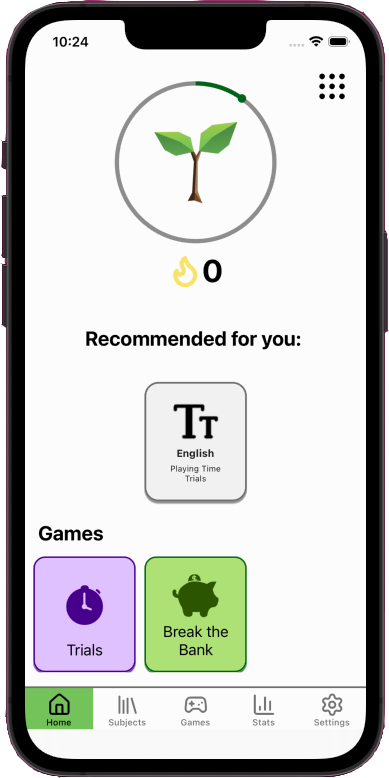
She downloads it and starts playing.
Maya installs Reach the week before winter break. Day one looks like every day after it: she opens the app and plays. What she is good at and what she keeps getting wrong, the app works out from how she answers — there is no placement test to sit and no plan for anyone to build.
Reach covers all four sections of the ACT: English, math, reading, and science.
January
The questions move toward what she keeps missing.
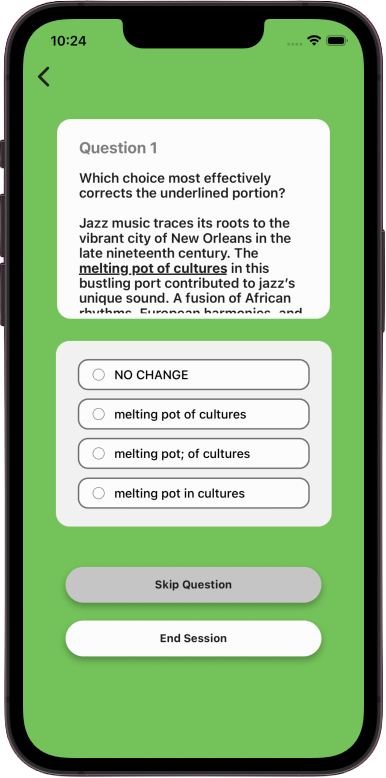
At first she gets a spread from across the whole test. As she answers, the questions narrow — toward the specific things she gets wrong, and away from the things she has already shown she can do.
When something about her is unclear, it widens again to find out. She never sees any of this happen. From where she is sitting, the questions simply change.
February
Her practice is weighted by what the test actually asks.
Two things set her pace: the score she is aiming for and the date she is testing. A junior sitting the ACT in two weeks who needs a 20 gets a different week of work than one testing in March who wants a 32.
A worked example
- Student
- Maya, junior
- Goal score
- 26
- Testing in
- April
- Losing points on
- Commas
So commas take up a large share of her practice — because commas take up a large share of the ACT’s English section. Reach spends her time where the points are.
Every week
What she sees is a game.
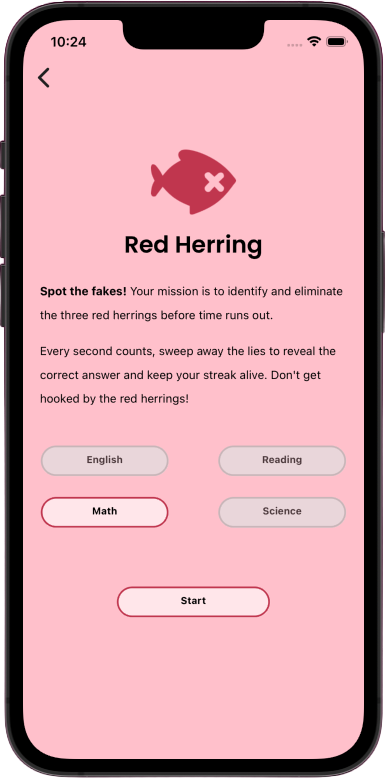
Trials, Break the Bank, Red Herring. Streaks to keep, quests to finish, challenges against the rest of her class. This is the part that decides whether any of the rest of it matters, because prep only works if a sixteen-year-old opens it a second time.
Students at partner schools average 7 hours a week — on buses, at lunch, after practice, on a Saturday morning. It costs your school day nothing.
Any Monday morning
What her teacher sees, the same week.
The second half of Reach for Schools is the teacher system. Everything the app learns about a student is reported back to the people teaching her. It opens in a browser, with an ordinary sign-in.
One student
What Maya has been working on, what she keeps missing, and where she stands — the screen a teacher opens before a conference.
The whole class
Every junior at once: who is putting hours in, who has gone quiet, and which skills the group as a whole is losing points on.
Projected scores
Where each student is heading if the current pace holds, with weeks still left on the calendar to change it.
Performance is reported against ACT standards, so a teacher can see which skills to reteach and where the curriculum needs adjusting.
March
A projected score, with weeks left to use it.
Reach maps a student’s practice results onto ACT scoring and reports where she is heading if her current pace holds. A teacher gets that read while there is still a term left to act on it.
It is a projection from practice, not a promise. We have not published accuracy data against real test-day scores, and we will not claim any until we have.
April
Test day.
Maya sits the ACT, and the worked example runs out here. What we can show you instead is what is happening at real schools right now.
One junior, then every junior.
- Schools running Reach
- 5
- Students
- 118
- Hours of prep logged
- 2,598
Measured from app analytics. Every figure here is hours and usage — score outcomes are something we will publish once we hold them.
Reach is the natural evolution of test prep.
My students just automatically felt comfortable doing test prep on Reach.
When I find myself doomscrolling, I go back to Reach.
Get your school’s number.
Reach is $10 per student in your junior class, billed up to the next $500 — and most of our schools pay nothing, because we go after a local sponsor together and they cover the bill for the whole building.
Sponsorship is the common outcome rather than a guarantee. We will tell you early if it looks unlikely for your school.